Az elmúlt öt évben a magyar egyetemek pozíciója folyamatosan romlott a QS-nél (a Műegyetem volt az egyetlen kivétel, a 2021-es 801-1000 csoportból a tavalyi nagy ugrás /741-750/ után idén már a 721-730 között van). Most ez a folyamat megállt, sőt, az ELTE, két kategóriát ugorva ennek az időszaknak a legjobb helyezését érte el (564, a 2021-es 601-650-nél is jobbat), Szeged és Debrecen pedig megközelítette a korábbi jobb pozícióikat (570 / 501-510 és 574/521-530). Pécsnek is javult a helyezése (771-780 a tavalyi 801-850 után), de a 2011-es 651-700-tól még mindig elmarad. A Corvinus a 2023-as jelentősebb hátralépés után tartósan az 1001-1200 közötti csoportban maradt, ahogyan a MATE és a Széchenyi Egyetem is itt található. Rajtuk kívül még Miskolc, Óbuda és a Pannon Egyetem kapott rangsorolást, mindannyian az 1201-1400-as sávban.
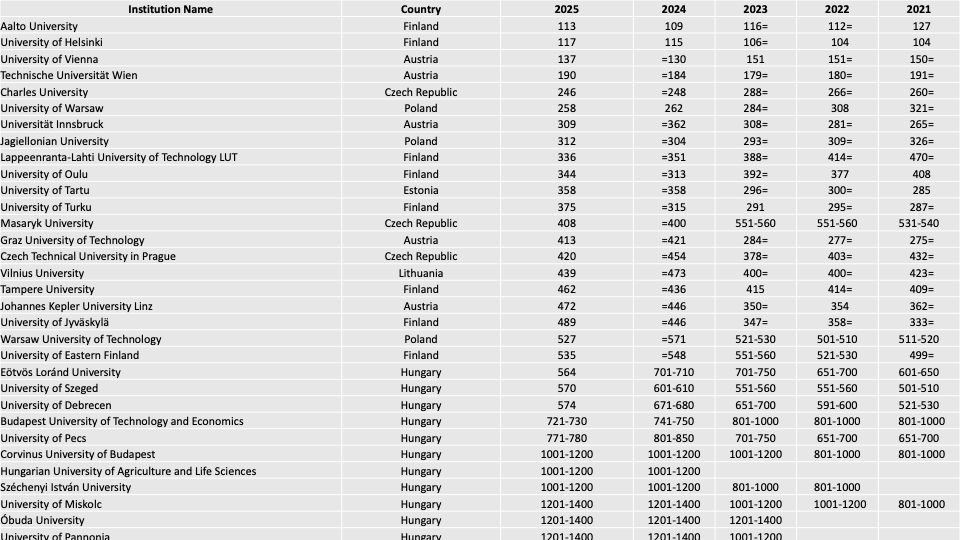
A régiós mezőnyben ezek a változások nem látszanak különlegesnek, az ezen az összehasonlítási platformon a magyar egyetemek nem javult. Megszokottan a prágai Károly Egyetemet szoktuk emlegetni a téréség előttünk álló intézményei között, de most már a Masaryk Egyetem valamint a cseh főváros Műszaki Egyeteme is tartósan és jelentős mértékben a magyar intézmények előttre sorolódik. Ugyanez a helyzet az észt Tartu Egyetemmel, a litván Vilnius Egyetemmel és a varsói Műszaki Egyetem is folyamatosan előbbre van – a krakkói Jagelló és a Varsói Egyetem esetében pedig az előnyük egyre inkább nőtt. A többi térségbeli egyetem pozíciója is hasonló mintázattal változott, mint a magyaroké: a cseheknél egykategóriás le-fel mozgásokat látunk, hasonlóan a lengyelekhez. Románia egyetemi a Banbes-Bolyai és a Bukaresti Egyetem kivételével maradtak vagy némileg rontottak a tavalyi pozíciókhoz képest, de jellemzően hátrébb sorolódva a magyar egyetemeknél. Szlovákiában is javulást látunk a legjobb helyre sorolt Comenius Egyetem esetében a 661-670 csoportba (valamennyire kisebb ugrással, mint az ELTE, hiszen itt a 771-780ból a tizenegy egységnyi csoporttal előbbre lévő 661-670-be), míg Ljubljana előbbre lépése csak kismértékű (596. hely a 621-631 után, ami viszont korábban, három évvel ezelőtt volt már 590-600. Szófia nagyobb előrelépése (661-670-re a tavalyi 751-760-hoz képest) egyfajta visszakapaszkodás a korábbi ötszázas mezőny felé, míg a Zágrábi Egyetem nagyobb ugrása egy trendnek a folytatása, (651-660), a Belgrádi Egyetem pedig beállni látszik a hétszázas nmezőnybe (731-740). Utóbbi azért is tanulságos, mert a Belgrádi Egyetem kifejezetten ranking-orientált fejlesztésbe kezdett a korábbi években, de ennek a határossága hamar kiderült.
Viszonyítási alapnak a világ fejlettebb felsőoktatási rendszereiből a régiónkhoz leginkább közelálló két ország, Ausztria és Finnország egyetemeit célszerű vizsgálni. Náluk lényegesen magasabb bázison mérhetőek az elmozdulások, hiszen valamennyi rangsorolt intézményük a QS ranking első felében található, többségük pedig az első ötszázban, sőt, a mindenkori magyar felsőoktatáspolitika számára mágikus első kétszázban is két-két osztrák és finn egyetem található. Érdekes ugyanakkor, hogy a térség mindenkori éllovasa, a Helsinki Egyetem fokozatosan kerül egyre hátrébb minden évben – de persze ez idén a 117. helyet jelenti. Így azonban már megelőzi az Aalto Egyetem (113.), amely az elmúlt évtized finn felsőoktatási fejlesztéseinek kulcsintézménye volt. Helsinki visszacsúsza ugyanakkor nem kivételes jelenség, hiszen a 18 listán szereplő osztrák vagy finn egyetemből 13-nak romlott a helyezése 2021-hez képest, sőt, köztük csak három esetében mutathat esetleg trendfordulót az előző évi eredményhez viszonyítás. A relációk tekintetében ugyanakkor ez nem jelent változást, hiszen 2021-ben ugyanúgy egy finn és három osztrák egyetem volt, aminél találhattunk akkor jobb pozícióban lévő magyart, mit idén.
Összefoglalva tehát, a vezető magyar egyetemek helyezésbeli előrelépése feltűnő, de nem egyedülálló jelenség a térségben, azonban az „ugrás” mértéke a tavalyi évhez képest nagyobb.
 Dr. habil György Fábri (1964) is an habilitated associate professor (Institute of research on Adult Education and Knowledge Management, Faculty of Education and Psychology of Eötvös Loránd University), head of the Social Communication Research Group. Areas of research: university philosophy, sociology of higher education and science, science communication, social communication, church sociology. His monograph was published on the transformation of Hungarian higher education during the change of regime (1992 Wien) and on university rankings (2017 Budapest). He has edited several scientific journals, and his university courses and publications cover communication theory, university philosophy, science communication, social representation, media and social philosophy, ethics, and church sociology.
 Mr. Degli Esposti is Full Professor at the Department of Computer Science and Engineering, Deputy Rector Alma Mater Studiorum Università di Bologna, Dean of Biblioteca Universitaria di Bologna, Head of Service for the health and safety of people in the workplace, President of the Alma Mater Foundation and Delegate for Rankings.
 Ben joined QS in 2002 and has led institutional performance insights function of QS since its emergence following the early success of the QS World University Rankings®. His team is, today, responsible for the operational management of all major QS research projects including the QS World University Rankings® and variants by region and subject. Comprising over 60 people in five international locations, the team also operate a widely adopted university rating system – QS Stars – and a range of commissioned business intelligence and strategic advisory services.Ben has travelled to over 50 countries and spoken on his research in almost 40. He has personally visited over 50 of the world’s top 100 universities amongst countless others and is a regular and sought after speaker on the conference circuit.Ben is married and has two sons; if he had any free time it would be spent reading, watching movies and skiing.
 Anna Urbanovics is a PhD student at Doctoral School of Public Administration Sciences of the University of Public Service, and studies Sociology Master of Arts at the Corvinus University of Budapest. She is graduated in International Security Studies Master of Arts at the University of Public Service. She does research in Scientometrics and International Relations.

 Dr. Mircea Dumitru is a Professor of Philosophy at the University of Bucharest (since 2004). Rector of the University of Bucharest (since 2011). President of the European Society of Analytic Philosophy (2011 – 2014). Corresponding Fellow of the Romanian Academy (since 2014). Minister of Education and Scientific Research (July 2016 – January 2017). Visiting Professor at Beijing Normal University (2017 – 2022). President of the International Institute of Philosophy (2017 – 2020). President of Balkan Universities Association (2019 – 2020). He holds a PhD in Philosophy at Tulane University, New Orleans, USA (1998) with a topic in modal logic and philosophy of mathematics, and another PhD in Philosophy at the University of Bucharest (1998) with a topic in philosophy of language. Invited Professor at Tulsa University (USA), CUNY (USA), NYU (USA), Lyon 3, ENS Lyon, University of Helsinki, CUPL (Beijing, China), Pekin University (Beijing, China). Main area of research: philosophical logic, metaphysics, and philosophy of language. Main publications: Modality and Incompleteness (UMI, Ann Arbor, 1998); Modalitate si incompletitudine, (Paideia Publishing House, 2001, in Romanian; the book received the Mircea Florian Prize of the Romanian Academy); Logic and Philosophical Explorations (Humanitas, Bucharest, 2004, in Romanian); Words, Theories, and Things. Quine in Focus (ed.) (Pelican, 2009); Truth (ed.) (Bucharest University Publishing House, 2013); article on the Philosophy of Kit Fine, in The Cambridge Dictionary of Philosophy, the Third Edition, Robert Audi (ed.) (Cambridge University Press, 2015), Metaphysics, Meaning, and Modality. Themes from Kit Fine (ed.) (Oxford University Press, forthcoming).
 Since 1 February 2019 Minister Palkovics as Government Commissioner has been responsible for the coordination of the tasks prescribed in Act XXIV of 2016 on the promulgation of the Agreement between the Government of Hungary and the Government of the People’s Republic of China on the development, implementation and financing of the Hungarian section of the Budapest-Belgrade Railway Reconstruction Project.
 He is the past President of the Health and Health Care Economics Section of the Hungarian Economics Association.

 Based in Berlin, Zuzanna Gorenstein is Head of Project of the German Rectors’ Conference (HRK) service project “International University Rankings” since 2019. Her work at HRK encompasses the conceptual development and implementation of targeted advisory, networking, and communication measures for German universities’ ranking officers. Before joining the HRK, Zuzanna Gorenstein herself served as ranking officer of Freie Universität Berlin.
 His books on mathematical modeling of chemical, biological, and other complex systems have been published by Princeton University Press, MIT Press, Springer Publishing house. His new book RANKING: The Unwritten Rules of the Social Game We All Play was published recently by the Oxford University Press, and is already under translation for several languages.